In the Middle School, students pursue their interests and are pushed to try new things. They are challenged, which means that in addition to taking tests, writing papers, and preparing for class, our students also apply their learning to explore concepts further, growing as students and individuals.
The Middle School curriculum goes beyond simply memorizing facts; students explore different paths to a solution and share that process to explain their conclusion. They blog, debate, build, draw, code, act, and present their ideas through movies, workshops, podcasts, and so much more.
This work is dynamic, engaging, and innovative, and it happens during and outside of class—in groups, and individually.
Whether presenting in front of the entire Middle School, reading a book in another language, or devising their own play, we encourage our students to do things they may have never done before (or never thought they could do). We also teach them how to work with their peers to accomplish many different tasks, how to count on others, and how to be counted on.
Middle School is a time to try, make a mistake, learn from that mistake, and try again—in a supported and safe environment filled with dedicated adults who love working with MS students and who are committed to doing all they can to help students find success.
We intentionally ensure our students thrive in Middle School and are prepared for what’s next—at Beaver, in Upper School, and the world beyond.
Tiffany Smith, Director of Middle School
Middle School Course Catalog
By default, courses are organized alphabetically by title; to see requirements by grade-level, select the specific grade you’re looking for in the “Grade” dropdown.
Afternoon Dance
This is a safe space for movers of all abilities to explore and work on their dance skills and learn fun choreography. The aim of this activity is to help students find confidence in their movement abilities, and challenge themselves to try different styles and to push past what they think they are capable while building a sense of community. Students can expect to work coordinating movement, improvisation, learning technique and choreography in a relaxed and fun environment.
Athletics
A strong athletics program begins in the Middle School. At this level, we focus on skill development, teamwork, and the dedication and commitment needed to be a successful athlete. We want our MS athletes to understand what it means to work together towards a common goal and support their teammates. Students are encouraged to try a new sport or activity, and our coaches share their knowledge in a supportive and engaging environment. Certain MS sports have “A” and “B” teams. Placement on these teams is based on skill, and while equal playing time is not guaranteed, every MS student will receive playing time and will participate.
BVR Fitness
BVR Fitness is a class where students will learn the basics of strength training, technique in the weight room, and develop skills that will help them prepare for other sports and lifelong health and wellness. Led by our Sports Performance Coach, this is a great way to get in shape and have some fun while doing it!
Chinese A
This introductory course exposes students to Chinese through comprehensible input, including oral, written, and visual storytelling. The input-based approach to acquiring language focuses on the instruction of vocabulary in a highly contextualized manner. By keeping the conversation/story engaging and compelling, the learner is distracted from consciously trying to memorize vocabulary. Class time centers around developing fluency and students are encouraged to use their language skills wholistically. Emphasis is placed on fluency over precision, with a focus on students being comfortable communicating in simple sentences in Chinese.
Chinese B
A continuation of Chinese A, in Chinese B students continue to develop their fluency in the language. This course exposes students to Chinese through comprehensible input, including oral, written, and visual storytelling. The input-based approach to acquiring language focuses on the instruction of vocabulary in a highly contextualized manner. By keeping the conversation/story engaging and compelling, the learner is distracted from consciously trying to memorize vocabulary. Class time centers around developing fluency and students are encouraged to use their language skills wholistically. Emphasis is placed on fluency over precision, with a focus on students being comfortable communicating in more detail in Chinese.
Chinese C
A continuation of Chinese B, in Chinese C students continue to develop their fluency in the language. This course exposes students to Chinese through comprehensible input, including oral, written, and visual storytelling. The input-based approach to acquiring language focuses on the instruction of vocabulary in a highly contextualized manner. By keeping the conversation/story engaging and compelling, the learner is distracted from consciously trying to memorize vocabulary. Class time centers around developing fluency, and students are encouraged to use their language skills holistically. Emphasis is placed on fluency over precision, with a focus on students being comfortable communicating in more detail and elaborating on their ideas entirely in Chinese.
English 7
Why are there stories? What makes a story? How are stories told? What is our story? These essential questions guide our reading, writing, and discussion in 7th grade English. Considering the essential elements of a story leads to an exploration of the many different ways stories are told: from spoken word through literature, poetry, drama, art and song, into more modern modes like podcasts, movies, and animation. We investigate the struggle to ensure rights for all citizens by largely focusing on fictional accounts highlighting the time period between 1920 and the present. We study the tactics of great readers, learning to be aware of our thought processes while we read, developing strategies to better understand a given text. We focus on the iterative writing process and supporting our ideas with adequate details while extending the depth and quality of our work. Creative problem solving, empathy, effort, and collaboration are our cornerstones and are always honored.
English 8
The 8th grade English course focuses on identity, with narratives involving adolescent characters reflecting on their interactions and experiences, responding to injustice, and questioning the status quo. Students respond to readings in a variety of modes: collaborative projects, personal reflections, expository essays, and creative compositions. The creative assignments allow individual freedom, stimulate imagination, and inspire risk-taking. Expository pieces prompt students to reflect on and respond to their readings and typically adhere to the five-paragraph format with the iterative process involving brainstorming, outlining, drafting, and revising. Students are encouraged to explore original modes of expression such as song, video, and visual arts. In general, emphasis is placed on development of creative problem-solving, collaboration, and study skills.
Fall Play: Acting
Students interested in theater can participate in the Middle School Fall Play as an afternoon activity. Working together as a cast and crew, students rehearse, develop characters, and help bring the production to life. The experience builds confidence, creativity, and collaboration, culminating in performances for the Beaver community.
Fall Play: Technical Theater
If you sign up for Afternoon Tech Theater in the fall, you will get to create the world of the fall play! In the days leading up to the performances, we might be building and painting scenery, finding sound effects, solving problems, making props, adjusting lights—basically making magic. In the two weeks leading up to the performances, you will learn how to run a show backstage. You might be in the booth watching the show while running lighting, sound, or projection cues, or backstage setting up scenery, solving problems, and saving the day. Both are exciting and fun!
Your saved courses
Middle School Academics Information
Middle school classes begin at 8:00 a.m. every day except Monday. On Monday, classes begin at 9:05 a.m. to allow for faculty meetings. (Students may arrive as early as 7:00 a.m. every day and eat breakfast and study quietly in the Dining Hall.). The school day ends at 3:45 p.m. every day, and most students leave at that time. If a student has an away sports game or a late drama rehearsal, he/she may not be able to leave until later in the afternoon.
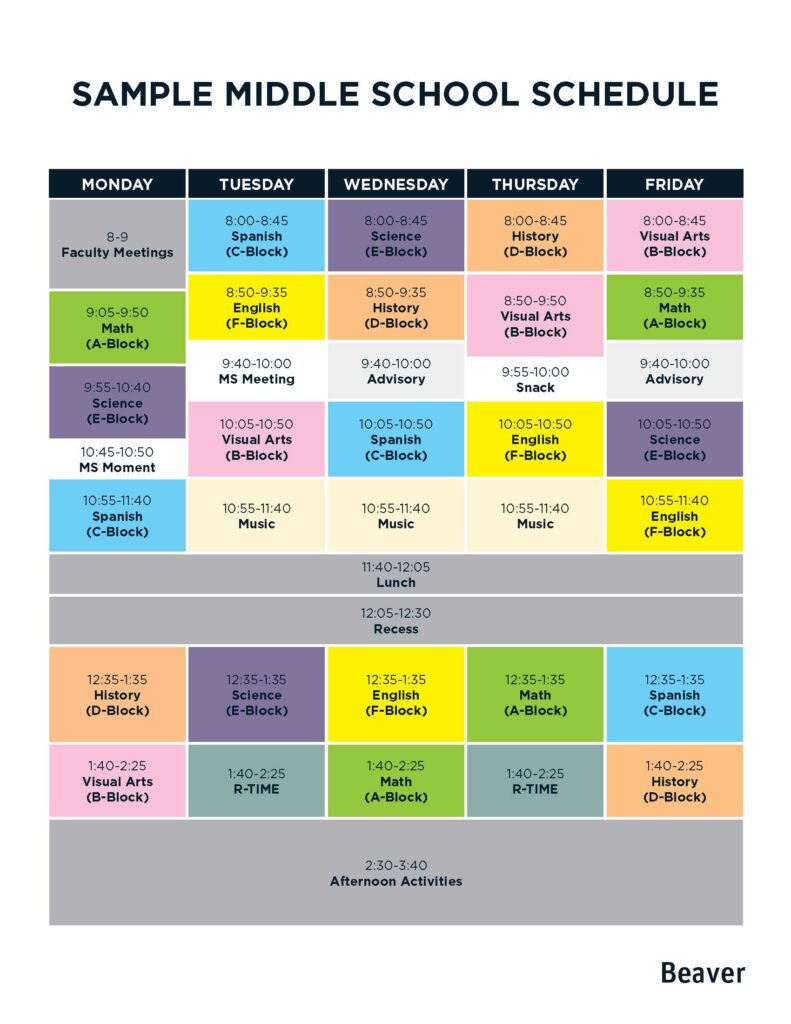
R-Time is a structured time (2x per week by advisory group) for students to do all sorts of things to support their learning. R-TIME is a great time to meet with teachers and peers, and students regularly visit Math R-Time to get extra help and dig deeper into topics. They can also complete assignments, grab a book from Research Level or the mobile library near Ms. Smith’s office, practice their instrument at Music R-TIME, work on their SIP (Student Inspired Project), clean out their backpack, and use some materials on the Design Level.
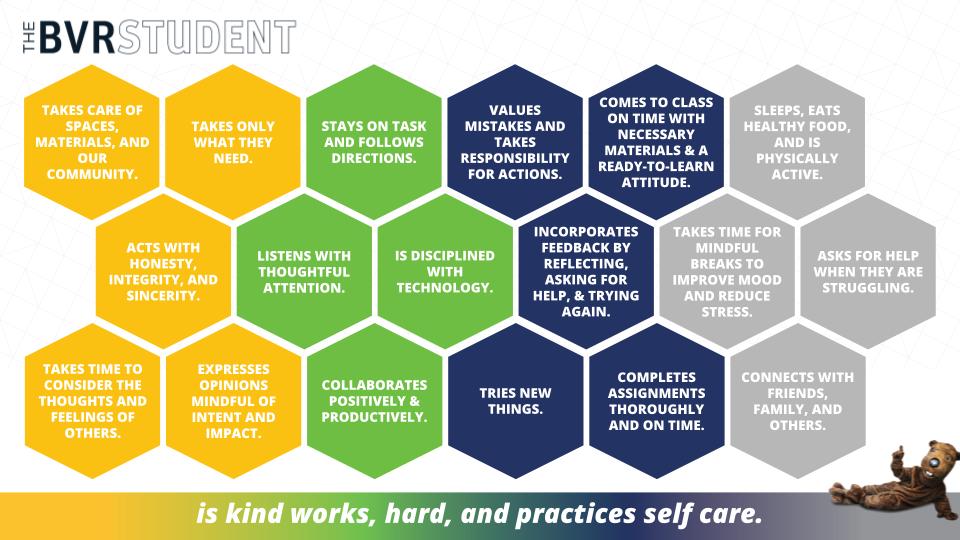
The “BVR Student” is a list of skills and habits that make up the whole student—the person they are in and out of the classroom. From working hard to being kind to practicing self care, we regularly reflect on this list as a Middle School community. This ensures our students get what they need to be successful in school and in the world.
We view technology as a tool to enhance learning. When it makes sense to use, we use it.
You can find more answers to commonly asked questions about the Middle School on our FAQ page.
Middle School Academic Contacts
-
Tiffany Smith
Director of Middle School
Tiffany Smith
I was born in Texas, and my father’s time in the military provided time spent in Texas, New York, Pennsylvania, and most memorably in Germany. Living overseas gave me the opportunity to interact with different people and cultures; an experience I still treasure to this day! I believe being an educator gives me the opportunity to have some say in how our world will continue to evolve and change for the better. Working directly with middle school students is truly the best parts of my day. I see middle school students as the most interesting young people, who are open to new experiences, looking for guidance support and humor. My job is to foster a place where great teachers facilitate learning with curious students ready to ask the next question and engage in new experiences.
-
Ann Bevan Hollos
Associate Director of Middle School
Ann Bevan Hollos
As a teacher and administrator for the last 16 years at independent middle schools in Pennsylvania, Colorado, and Massachusetts, Ann Bevan is committed to creating lessons that push students to think critically. As the Associate Director of the Middle School, Ann Bevan supports faculty in doing the same. At Beaver since 2004, her job includes managing all aspects of middle school student life, including discipline, scheduling, and coordination of the afternoon programs. Ann Bevan particularly enjoys helping foster student leadership skills via student council and facilitation of morning meetings. In 2006-07, she coordinated Beaver’s ten-year NEASC re-accreditation process, which gave her greater insight into virtually every aspect of the school, from curriculum to governance to student experience. Beaver is always examining what it does and thinking about ways to be better, a philosophy that fits well with her own dedication to seeing life as a set of experiences from which to learn.
-
Terri Flannery
Associate Director of Academic Services
Terri Flannery
With much to balance in their lives, it is important that our students be trained to use tools and strategies that help them be most effective and successful as learners. As Associate Director of Academic Services and a member of the Middle School Support Team, I collaborate to provide direct and indirect support to students, teachers, and parents/guardians throughout the school year. I also keep up to date with the most well researched techniques to improve student learning. Additionally, I advise seventh graders. Since joining Beaver in 2001, I have valued working in an environment that promotes critical thinking, creativity, collaboration, reflection, and empathy throughout the community. The chance to see a student have an “a-ha” moment or beam with pride at an accomplishment is what motivates me the most.