Since 1920, Beaver has given students the power to excel in any circumstance. Beaver challenges students to go beyond mastery of content and conventional problem-solving; we prepare students for an undefined era where the New Basics are the cornerstones of professional success and personal development.
Our Approach
We promote the success of every student by developing their full intellectual, personal, and social potential.
At Beaver, we teach all students the same core body of knowledge, ensuring no academic gaps. We push and stretch minds so kids become capable of addressing every and any imaginable intellectual task. We place great effort on teaching kids how to think with the utmost speed, accuracy, agility, balance, strength, stamina, flexibility and control.
We take private school education to a whole new level with mentor teachers, a student-centered class experience and thematically-driven curriculum which we believe allows students to better acquire, retain and master the usage of principles and content. Unlike traditional private schools, we do not train students to simply know content through memorization and repetition. At Beaver students learn content through the use of advanced thinking skills.
The cornerstones to the Beaver education:

Beaver's guiding principles
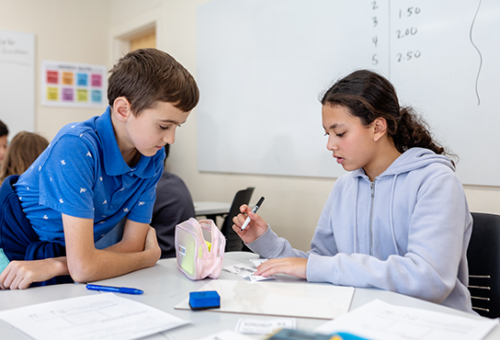
Our student-centered classrooms focus on teaching each individual. The traditional curriculum-centered classrooms are where the teacher determines what ought to be taught, when, how, and in what time frame. The curriculum that must be covered throughout the year takes precedence, and these classes often require strict discipline because children’s interests are considered only after content requirements are established. At Beaver the teacher’s role is to facilitate growth by utilizing the interests and unique needs of each student as a guide for meaningful instruction. These classrooms are goal-based, thematic and offer frequent experiential learning.
We see each student for who they are. We encourage, utilize and reward individuality as an integral part of the learning process. We push students to arrive at their own version of the truth, influenced by their own background, culture or embedded worldview. We help students construct their own understanding so that they do not simply mirror and reflect what they read from others.
Beaver students are actively involved in their education. Instead of the responsibility resting entirely with the instructor with the student playing a passive, receptive role, we give ownership in the process to the student which is highly motivating.
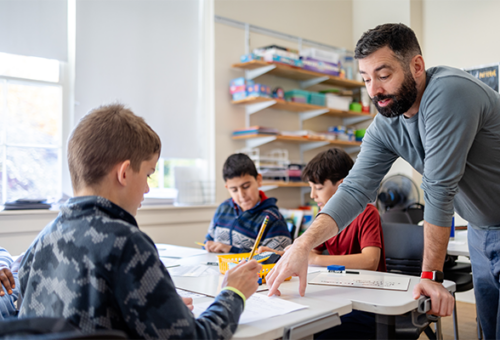
Our mentor teacher model recognizes the importance of the relationship between the student and instructor and is a cornerstone of our educational experience. At Beaver students take an active role and teachers facilitate that action so that emphasis is on the students. We engage students while they are completing activities, wondering aloud and we pose questions to the them for the promotion of reasoning and push them to figure things out for themselves.
A facilitator is a different way of teaching. A teacher tells, a facilitator asks; a teacher lectures from the front, a facilitator supports from the back; a teacher gives answers according to a set curriculum, a facilitator provides guidelines and creates the environment for the learner to arrive at his or her own conclusions; a teacher mostly gives a monologue, a facilitator is in continuous dialogue with the learners.
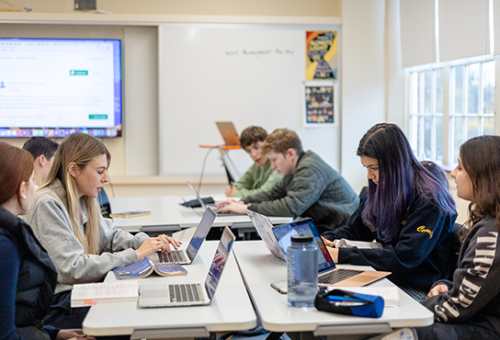
We address the collaborative and social dimensions of learning. We teach students to learn through interactions with each other and with the environment they live in. Knowledge is socially and culturally constructed. The learning experience becomes a shared enterprise where the emotions and life contexts of those involved are an integral part. Kids compare their version of the truth with that of the instructor and fellow students to get to a new, socially tested version of truth. Techniques used include Reciprocal Questioning, Jigsaw Classroom, Structured Controversies: Students work together to research controversies, peer collaboration, cognitive apprenticeship, problem-based instruction, web quests and anchored instruction.
In traditional education, academic disciplines are taught discreetly, and students learn subjects in isolation from one another. We believe that knowledge should not be divided into different subjects or compartments, but should be discovered within an integrated whole. This underlines the importance of the context in which learning is presented. The real world does not approach students in the form of different subjects, but as a complex myriad of facts, problems and dimensions.
It is important to achieve the right balance between structure and flexibility. The more structured the learning environment, the harder it is for students to construct meaning based on their conceptual understandings. We structure the learning experience just enough for students to get clear guidance and parameters and keep it open and free enough to allow them to discover, enjoy, interact and arrive at their own answers. We use inquiry-based learning, problem-based learning, cognitive apprenticeships, cooperative learning and approaches to solutions that are embedded in a narrative environment.
Rather than viewing assessment as a process carried out by one person, such as an instructor, it is seen as a two-way process involving interaction between both instructor and student. It is a continuous and interactive process that measures the achievement of the student, the quality of the learning experience and courseware.
Academics, Courses, & College