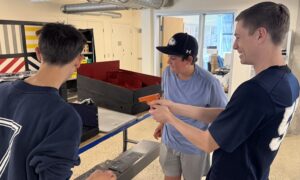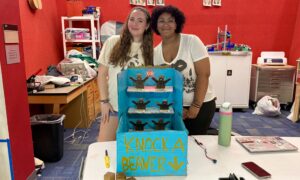
Students in Physics Applications leveraged their understanding of engineering to design, code, and wire fully playable carnival games. The assignment tasked students with reverse engineering common gameplay mechanics to create a game that is “easy to play, hard to master.”
The second term of 9th grade physics is focused entirely on engineering principles, helping students develop foundational skills such as wiring LEDs and switches, using Arduino microcontrollers, and solving voltage drop equations. To make their games function, students had to use these skills and deconstruct each step of the planning process: how would sensors track progress? How would scoreboards, lights, or sound bring the game to life? How should electronic components interact with the physical housing of the game?
[Students] use their knowledge of voltage, current, resistance, code, wiring, and design to make a fun game for others to play. They often don’t realize how much knowledge they are using or how it is growing . . . They first have to figure out the problem and then solve it.
Drew Zachry, Upper School Science
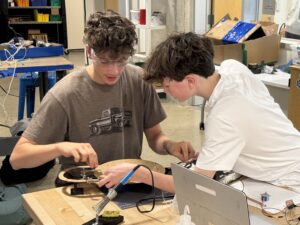
Students spent a majority of the time allotted for the project on the Design Level, using tools such as laser cutters, 3D printers, and soldering stations to actualize their ideas. Iteration became a key element of the assignment as students realized their designs would need constant revision and experimentation in order to work. “The hardest part of the project was debugging and issues with the coding,” Katie Born ‘28 says. “You have to find ways to fix every issue.”
As described by Upper School Science Teacher Drew Zachry, the process of the assignment is similar to a hero’s journey. “They get very excited about their game and everything is great. . . but then they trudge into the dark forest as code doesn’t work, the wires come unplugged, or they have to start anew on their 4th iteration of their design,” he explains. “But in the hero’s journey the only way through the dark forest is to keep going. . . and the students do keep going; they work during free periods and after school, they use their friends and all the great staff we have to help them. They come out the other side with a great project and feeling so proud of themselves.”
My favorite part of the project was seeing the final product. Watching people having fun playing it was awesome.
Arianna King '28

After finishing their designs, students hosted a carnival on the D-Level to showcase their work. Middle School students and faculty toured the games, earning tickets and trying to secure high scores. No two games were alike; from plinko to skee-ball to “knock a beaver,” students capitalized on the creative freedom of the assignment by personalizing their work.
We use physics and engineering as a tool to show [students] how much grit, tenacity, talent, and drive they have. So the next time they go into the dark forest, they know how to get out.
Drew Zachry, Upper School Science