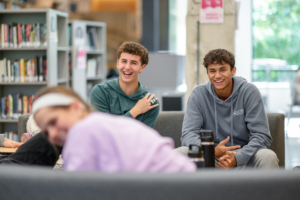
My favorite part of the week at Beaver is the time I get to spend with my advisory group. I have a wonderful crew of ninth graders, and regardless of what else is happening in my day, time with students is consistently the most important and fulfilling part of the work. Sitting with the kids, hearing what’s on their minds, laughing together, walking with them through difficult moments, and getting to know them as individuals is a privilege of being an educator.
I’ve told my advisees that my role as their advisor is, in many ways, a smaller version of my responsibility as Director of Upper School. My first job is to know and care for the young people entrusted to us. That means understanding them as humans first and students second. It means recognizing that the student sitting in front of us is so much more than a grade, a transcript, a behavior, or a moment in time. And it means making sure that every student feels seen, heard, and valued. No one can be allowed to fall through the cracks. I consider that my number one responsibility.
I’ve spent these first few months at Beaver thinking a great deal about what it means to belong to a community. Even as an adult with significant experience in schools, there is something both exciting and vulnerable about entering a new environment, learning its rhythms, building relationships, and finding one’s place and people. That experience has made me think about what our students navigate every day, particularly during adolescence, when questions about identity, friendship, acceptance, and belonging feel especially significant.
I recently came across an interview with Jennifer Breheny Wallace about her work on mattering, and it expressed something I have always believed is central to education. Wallace explores the distinction between belonging to a community vs. feeling that you genuinely matter within it. It’s possible to be included, to participate, and to be surrounded by people without necessarily feeling that your presence makes a difference. Mattering asks us to go a little deeper. Do I feel valued for who I am? Do people notice when I’m struggling? Do I have something meaningful to contribute? Maybe our kids are asking those very questions (likely quietly, internally, and without ever sharing them with a trusted adult!).
At Beaver, we want all students to know that they are known, valued, and loved. We want young people to experience a school community where adults care about them—not simply because of what they achieve (and they do achieve amazing things), but because of who they are. That care doesn’t mean lowering expectations or removing challenges. In fact, sometimes knowing and loving a student means holding them accountable, having a difficult conversation, or encouraging them to do something they aren’t quite sure they can do. It means believing in their capacity to grow while making sure they don’t have to navigate that growth alone.
A quick example. With the November 1 early college deadline just behind us, I’ve been thinking about the extraordinary work of our college counselors. I’ve had the opportunity to see the care and thoughtfulness that go into the letters they write on behalf of our seniors, and it is genuinely stunning to witness how well they know their kids. Their words go far beyond grades, activities, and accomplishments to capture personalities, individual journeys, and the qualities that make them uniquely themselves. It is incredibly moving to see a young person reflected so thoughtfully through the eyes of an adult who has taken the time to really know them. This is such a powerful example of what we mean when we say students are known and loved at Beaver. Deep relationships matter—and have ongoing impact! And this is just one example of the many adults who take the time to know and value every kid here.
A related part of this work is just as important. We don’t simply want students to experience what it feels like to be known and loved. We want them to learn how to know and love others in a world that—let’s be frank—may not always give them the best examples of that. Adolescence is a time when young people are working to understand themselves, and we have an opportunity to help them look beyond themselves. We want them to listen to people whose experiences differ from their own, approach unfamiliar perspectives with curiosity, and recognize that every person carries a story they may not fully understand. Belonging isn’t just something we receive from a community. It’s something we have a responsibility to create for others.
Beaver intentionally creates opportunities for students to practice this kind of thinking. Last year, for example, the Hiatt Center explored immigration as a focus of its work, shaped by students’ own interests and questions. I love that example because it demonstrates something essential about student-centered education. When young people ask meaningful questions about the world, we take those questions seriously. We create opportunities for them to investigate complicated issues, encounter different perspectives, and better understand the experiences of people whose lives may look different from their own.
Our global travel opportunities offer another way for students to expand their understanding of the world and the people who inhabit it. And programs like TEDxBeaverCountryDaySchool or our Student-Directed Projects reflect our commitment to student voice, giving young people opportunities to explore ideas that matter to them and share those ideas with a broader audience. When we invite students to speak, we communicate that their perspectives have value. When we ask them to listen thoughtfully to one another, we help them recognize that the same is true for everyone else.
Of course, this work doesn’t happen only through special programs or experiences. It happens in classrooms, in advisory, in athletics and arts programs, and in the ordinary interactions that shape our days. Those moments might not appear on a transcript or in a college application, but I would argue that they are among the most meaningful parts of a progressive education.
In November, a month that naturally invites us to think about gratitude and community, I find myself particularly grateful for the opportunity to know the students at Beaver. I am grateful for the stories they share, the questions they ask, and the ways they somehow always surprise me. And I’m grateful to be part of a school that believes knowing students well isn’t something separate from the work of educating them. It is the very heart of that work.
My hope is that every student who walks through our doors feels that they matter, not because they have earned that feeling through achievement or recognition, but simply because they are here and because they are themselves. And my hope is that, over time, they carry that understanding beyond Beaver, recognizing their own worth while helping others recognize theirs. Because ultimately, I don’t think our goal is simply to create a school where students feel they belong. When they feel they belong and know they matter, it will help them become people who create belonging for others, wherever they go.