The following post was written by Lizzie Conklin, an intern at Beaver Country Day School and assistant to painter Joel Janowitz. She is currently interning in various departments at Beaver—including Visual Arts and Marketing. She hopes to one day be an artist.
As Lisa Brown walked me to our meeting, she bounced seamlessly from teacher mode to interview mode. She juggled a student seeking essay help, a student asking for a copy of The Great Gatsby (of which she has three), and a student celebrating “Bagel Day” (when multicolor bagels with rainbow sprinkle cream cheese are served at lunch), all while I probed her about her class called “Money, Money, Money.”
Ms. Brown—head of the English Department at Beaver and Upper School teacher—has taught The Great Gatsby long enough to have a copy that looks like you need special gloves and only natural light to handle it.
“Students had always loved talking about money and society within Gatsby,” Ms. Brown said.
When a group of juniors was asked what they wanted more of in their education, they asked for a class that focused solely on the dynamic between money and power in society.
“So you want a class called Money, Money, Money,” Ms. Brown joked.
But that’s exactly what they got.
In Money, Money, Money, students analyze the association between money and power in our world. They analyze how money intersects with power in all fields—money in politics, money in climate, money in sports, money in film. etc. They examine “how people are corrupted, where the tension is,” and constantly pose questions that arise from such concepts.
When they’re not brainstorming essential questions, students read Nickel Boys by Colson Whitehead and Death of a Salesman by Arthur Miller. They watch the third season of The Wire.
“Good television doesn’t simplify anything,” Ms. Brown told me when I was confused yet enthused by the idea of watching TV in class. “It makes us see that [the issues dealt with] are real, human problems.”
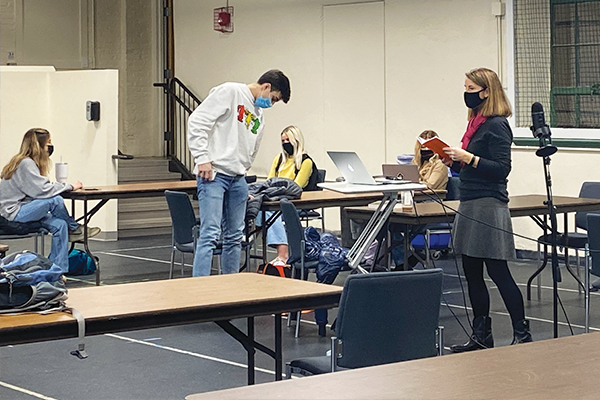
Students interview real people, too. In one of their recent assignments, they were asked to interview an adult about money—“what have been their greatest mistakes and how did they form their ethos around money.” Through this, students begin to draw their own conclusions about their own financial life.
“For Ms. Brown’s Money Money Money class, my friends and I presented about the growth of the film industry and how it’s being taken over by streaming services like Netflix,” said Senior Thomas Dies. “This project was super engaging—while working on it, we were able to dive deep on budgets for big Hollywood films. Learning about how much money needs to be set aside for visual effects, paying the actors, marketing and more is very interesting! On top of that, the meteoric rise of Netflix actually didn’t happen overnight, as they barely even returned a profit until 2020!”
As our discussion finished up (when one student hand-delivered bagels to another and they literally broke bread), I asked Ms. Brown how her students have surprised her this term. She had an immediate answer. Each day, one student poses a prompt that they came up with for the class to discuss.
“They’ve asked the most amazing questions about how people value money and what the relationship between money and power is,” she said. “One student asked, ‘If you and your family did NOT apply for financial aid during the college process, but you received merit money from a school, how would you react? would you keep it? why?’ Another student asked their peers ‘Do you loan money? Do you borrow money? At what amount will you ask for it back?’”
Ms. Brown focuses on what the students bring to her. She values each individual and what they themself bring to class. When a student forgets their book, she pulls out three copies and lets them choose which one they want. When a student interrupts to announce that it’s Bagel Day, she celebrates with them. As laptops were closed and papers shuffled around, I realized that Ms. Brown had not been bouncing between teacher and interviewee—she was simply herself, a teacher to her core, who can’t help but be patient and share (with joy) all that her students give to her.